Schools
How the 'Saskatoon Lily' went from tiny town to Olympic record holder
By Tommy Anderson
Advertisement · Why this ad?
Emily Thorson has been reporting in North Dakota for over 15 years, after earning her degree in Journalism from North Dakota State University. Previously, she served as the editor of the Minot Daily News, where she honed her skills in community engagement and storytelling. Her passion for local issues drives her commitment to give a voice to Jamestown's residents.
More from Emily →
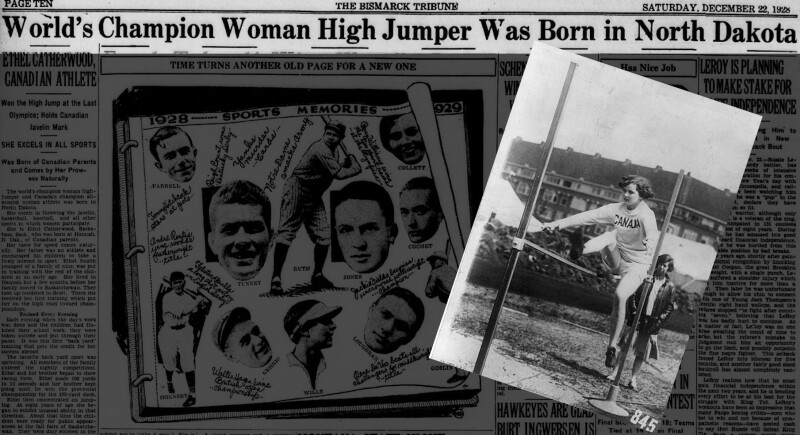
Illustration by C.S. Hagen / Forum News Service By C.S. Hagen Today at 1:10 PM Listen Comments Share Share this article News Reporting News Reporting Based on facts, either observed and verified firsthand by the reporter, or reported and verified from knowledgeable sources. The Trust Project What is this? HANNAH, N.D. — Ethel Catherwood’s journey to winning a gold medal in the Olympics began in her backyard. She became an international celebrity, nicknamed the Saskatoon Lily and described by the New York Times as the “prettiest girl” at the 1928 Olympics. “Sports writers stretched their imaginations to find a word that might even remotely describe her loveliness. Reporters coined new flower-phrases in her honor,” the Winnipeg Tribune reported. ADVERTISEMENT Hounded by reporters from around the world, Catherwood became the most photographed female athlete during the Amsterdam Olympics, where she set a new high jump world record, which lasted 378 days. Contributed / Edmonton Journal via Newspapers.com And then she shunned it all — the glamour, the Hollywood prospects. “I’d rather gulp poison than try my hand at motion pictures,” she told reporters in 1928, according to the Olympics website. Ethel chose to use the $3,000 and more award money for studying piano and working as a secretary in Toronto. In 1987, after at least two failed marriages, she died in relative obscurity. Her neighbors didn’t know she was a 1928 gold medalist, one of the few women to win a gold medal in track and field for Canada, according to The Union, a newspaper in Grass Valley, California. To this day, reporters ask a question that eludes an answer: what happened? Small-town roots Ethel was born in Hannah, where her parents had spent many years. The family moved to Saskatchewan within a year after she was born. By the time she could run, she began training with her eight siblings under her father’s tutelage in the backyard. ADVERTISEMENT Contributed / Free Press Prairie Farmer via Newspapers.com Her father, Joe, could “shake a wicked foot himself in his younger days in North Dakota” and made training fun. Every day after school and chores, the nine children would practice running, basketball, baseball and jumping, according to the Leader-Post, a newspaper in Regina, Saskatchewan. Growing up as the fourth youngest, Ethel was known as the “wee girl,” but in her teens, she grew to stand 5 feet, 10 1/2 inches. Contributed / Bismarck Tribune via Newspapers.com Ethel enjoyed the training, telling reporters in 1928 she would quit the day athletics became a chore. Despite her love of speed and bursts of power, her outlook on life was to “take it easy. To take training seriously would just kill the fun,” the Winnipeg Tribune reported. She became the “girl who has never known defeat,” who never went on any kind of diet for fear the strain would “kill the sport,” the Winnipeg Tribune reported in a feature story about Ethel. She was Canada’s girl, but North Dakota tried to claim her as their own. She became the state’s long-lost daughter as she raced her way to the 1928 Olympics, smashing records with every meet. “As far as known Miss Catherwood is the only person even remotely connected with North Dakota who has even competed in Olympic games,” according to the Grand Forks Herald. One other, Vern Booth, of Velva, North Dakota, tried out for the Olympic team in 1924, but failed. Contributed / The Leader-Post via Newspapers.com Quick climb to the Olympics Trained by her father in the backyard until she was 15, she cleared a high jump of 5 feet after she made a wager with her dad. A week later, they made another bet, and she broke the world record of 5 feet, 4 inches. At collegiate meets, she repeatedly won the high jump and took first-place prizes for the 50-, 75- and 100-yard dash. ADVERTISEMENT The University of Saskatchewan coach, Joe Griffith, took notice of her, and brought her from her backyard training to college, where she continued to smash previously set records, which easily paved her way to the 1928 Olympics. Contributed / US Library of Congress 1928 Olympics The Games of the IX Olympiad was a first in many categories. It was the first time women were allowed to compete in select events; it was the first time the flame appeared atop a marathon tower at the Olympic Stadium. It was also the first opening ceremony where the Parade of Nations began — beginning with Greece and ending with the host country — The Netherlands. A Coca Cola sponsorship began with a ship carrying 1,000 crates. The birth of the “P” parking sign also began in Amsterdam after police created the blue-and-white sign specifically for the 1928 games to manage massive bicycle and car congestion near the stadium. Ethel’s main high jump competition was a Dutchwoman named Carolina “Lien” Gisolf, a crowd favorite with the home country advantage. Catherwood beat her in 1928 to win the gold medal, but Gisolf later broke Catherwood’s record, according to the Guardian in England. After bringing home the gold for the high jump, Ethel toured Europe before returning to a tumultuous parade in Canada, where she was presented with a $3,000 gift as an educational trust fund. Later, she used some of the grant money to study piano, the Star-Phoenix newspaper reported. ADVERTISEMENT Contributed / Winnipeg Tribune via Newspapers.com After the Olympics When interviewed by reporters with the Bismarck Tribune, they asked her if she believed a woman could handle a marriage, family and public life. Would she give up athletics for marriage? “Miss Catherwood simply dismissed the topic with a shrug, which plainly said, ‘I am not interested in the subject,’ ” the Bismarck Tribune reported. Contributed / Forum of Fargo-Moorhead via Newspapers.com “Apocryphal stories abound about Catherwood’s life after Amsterdam. It is said that she never competed again. It has also been written that she married the 1924 Olympic high jump and decathlon champion, Harold Osborn,” the Olympics website reported. Neither story was true. She continued to compete, winning some local competitions and taking third place at a meet in Alberta after repeated injuries. Her first marriage was done in secret, according to The Union. She married 22-year-old bank teller James McLaren, never telling her parents. Later, she admitted it was a mistake, but soon after, she married again, which lasted until 1960. At 52, she settled in Grass Valley and slipped into obscurity. She shunned any publicity, and nobody in her community knew she was an Olympic gold medalist. ADVERTISEMENT Struggling with cancer, she ended her own life shortly after promising a California reporter one last interview. The interview was never held, and there was no obituary for her. Nobody knew why she became so bitter and reclusive. “Why did she refuse all interview requests during the final three decades of her life? We will never know, because on Sept. 26, 1987, deciding that additional cancer treatments would be futile, the enigmatic Saskatoon Lily took her own life at the house in Grass Valley,” The Union reported. “If there ever was an enigma, it was Ethel. But if you knew longtime Grass Valley resident Ethel Mitchell, then you knew Ethel Catherwood… a star of the 1928 Olympics,” The Union reported. Catherwood and a team of Canadian women were part of the "Matchless Six," which collectively brought back four medals and secured women's place in Olympic track and field, according to a commemorative plaque dedicated to her by the Historic Sites and Monuments Board of Canada. "This world-class high jumper helped break down barriers for women in track and field, while facing widespread sexism and unwanted attention as a woman," the plaque stated. "She set multiple national and world records in high jump and javelin between 1926 and 1930 at a time when women began competing in athletic events internationally." Comments Share Share thi
By Tommy Anderson

By Lillian Becker

By James Larson

By Erik Svenson